Define the snubber position before choosing a part
The MKPH-S page describes IGBT buffer circuits and lists IGBT snubbing and switch-mode power supplies as applications. That establishes the product's intended role in the catalog. It does not mean that a capacitor can be selected solely from the power rating of an inverter or supply. The relevant information is the duty at the specific snubber position.
Include a circuit extract showing where the capacitor connects and explain the switching conditions under review. Send waveform information if it is available, with the measurement point and operating state clearly identified. If the request is for a replacement, provide the existing component specification and the reason for changing it. These steps help the technical review focus on the actual snubber requirement rather than treating every capacitor in the same power assembly as electrically equivalent.
Read the family range alongside the proposed configuration
The published voltage range is 700 to 3000 VDC, while the capacitance range is 0.047 to 6.8 microfarads. These are family boundaries. They do not imply that the largest capacitance is available at every voltage or in every terminal arrangement. The candidate part needs to be identified with its particular dimensions and electrical data.
State the required capacitance and tolerance, normal voltage, and relevant voltage excursions. Identify which values are circuit requirements and which are preliminary preferences. Ask the supplier to confirm the proposed configuration as a whole, including the interface drawing. For purchasing comparisons, keep the same requirements in each inquiry so that a lower price is not being compared against a different voltage, pulse condition, or package. A nominal value by itself is an incomplete basis for a snubber capacitor order.
Terminal geometry belongs in the electrical discussion
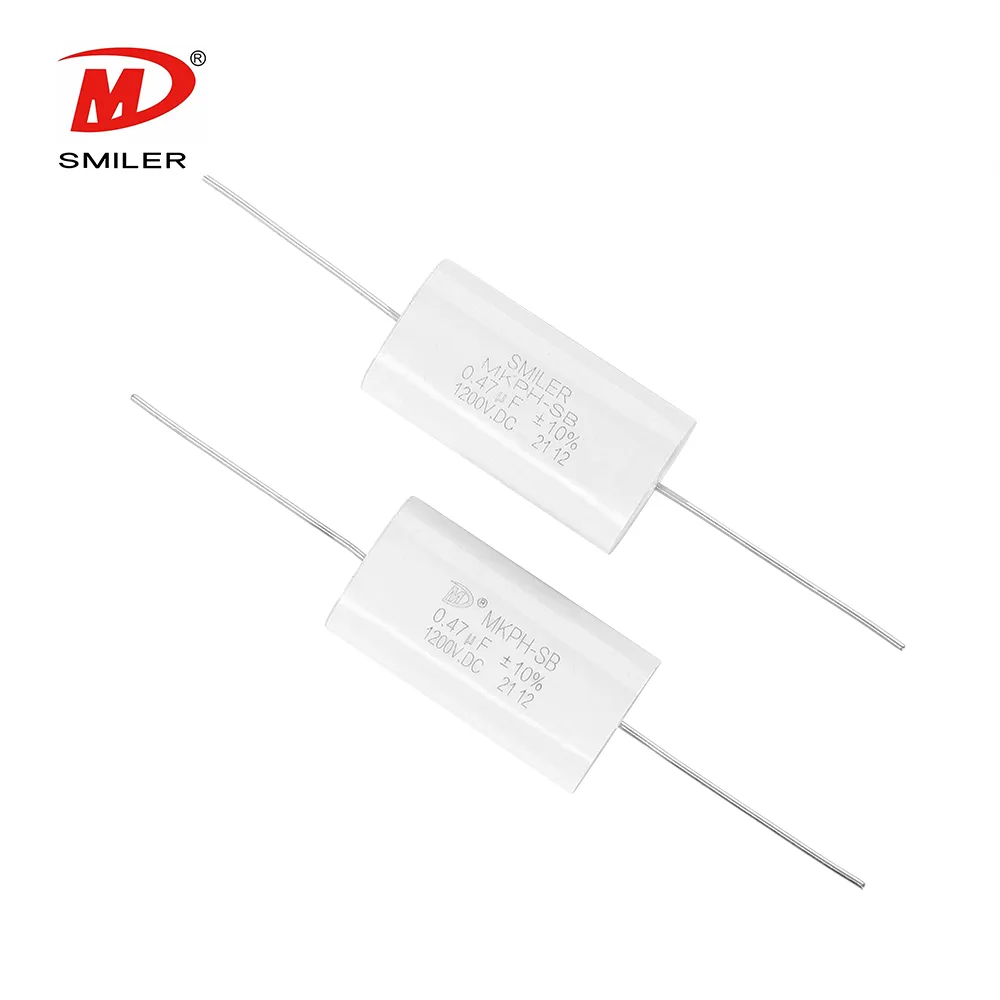
MKPH-S is described as a terminal-type product with a plastic case. Its source drawing presents multiple terminal arrangements. The physical connection therefore needs an early review, especially where the capacitor must fit an established assembly. A photograph can help identify the style but should not be used as the manufacturing interface definition.
Send the connection drawing, mounting envelope, and any access constraints around the switching assembly. Request dimensions for the proposed terminal version and confirm how it will be identified in the order documentation. Do not infer that two arrangements with similar outside dimensions use the same mounting details. Keep the selected terminal arrangement linked to the electrical specification throughout sampling. Changing the interface after an initial evaluation should trigger a review of whether the approved arrangement still represents the production installation.

Pulse, repetition, and thermal duty need separate attention
The product description emphasizes pulse capability and self-healing behavior. Those features make MKPH-S a candidate for a snubber discussion, but they do not establish a universal pulse current limit. A useful electrical brief includes the voltage transition, pulse pattern, repetition conditions, and current information relevant to the intended operating modes.
Ask for the selected part's pulse and current data with their stated conditions. Keep short-duration stress information separate from the continuing thermal duty of repeated operation. When comparing data, preserve the frequency and temperature associated with each value rather than extracting a single favorable number. If you have measured waveforms, retain the test setup and operating state with the inquiry. This makes later sample observations easier to interpret and avoids turning a qualitative family feature into a precise performance promise that has not been agreed.
Higher temperature operation carries voltage conditions
The MKPH-S specification describes a maximum case temperature of 105 degrees Celsius with voltage derating between 85 and 105 degrees Celsius. The published derating is 1.33 percent per degree Celsius relative to the operating voltage at 85 degrees Celsius. Buyers should retain that relationship rather than combining the highest temperature with an unqualified full-voltage claim.
Provide the intended local temperature and identify the measurement location. Ask the technical team to confirm the applicable limits for the proposed part and duty. The source also gives an operating-life statement of 100000 hours at rated voltage and a hotspot temperature of 70 degrees Celsius. That condition differs from the maximum-temperature description. It is not a warranty or evidence of the same lifetime at the temperature limit. Keep lifetime expectations and maximum operating limits separate in the design review.
Prepare an IGBT assembly evaluation that answers a question
Before requesting samples, decide what the evaluation is intended to establish. It may need to confirm fit within an existing interface, assess the observed switching behavior, or support a controlled component substitution. State that purpose and define the acceptance criteria with the equipment team. This is a suggested qualification approach, not a claim that MKPH-S has already been tested in your assembly.
Record the circuit revision, terminal configuration, operating mode, and relevant temperature observations when comparing candidates. If the switching arrangement changes, review whether the original sample findings remain applicable. For a production substitution, retain the original requirement and the accepted replacement evidence in the same approval record. A successful trial should result in an identifiable part specification, rather than a general approval to use any capacitor carrying the same family name.
Have a drawing or target specification?
Include it in your first message so the conversation starts with your equipment requirements.
Start a technical inquirySend a snubber RFQ with the switching context
An MKPH-S inquiry is strongest when it shows the snubber position in the circuit. Include the required capacitance and tolerance, voltage behavior, pulse information, repetition conditions, and available temperature data. Identify the operating mode behind each waveform or estimate. If a requirement has not yet been measured, mark it as provisional rather than presenting an assumed value as an established design limit.
Attach the connection drawing and show the terminal arrangement that the assembly requires. State the available envelope, mounting interface, and access restrictions. If several terminal versions could work, request that each proposed version be identified separately with its drawing. For a substitution, provide the previous component specification and explain the reason for change so the technical comparison addresses the same equipment requirement.
Ask for sample availability and commercial terms against the selected configuration. Separate sample demand from production demand, and request minimum quantity, packaging, and timing without assuming those terms are standard across the family. If product documentation is needed for an equipment approval, state its scope. The technical data, terminal version, and commercial offer should refer to one identifiable proposal before purchasing begins.
Identify terminal types by the complete outline
The MKPH-S outline information distinguishes Types A and C with an M6 mounting-hole designation and Types B and D with an M8 designation. Those labels provide a concrete starting point for an interface discussion. They do not mean that all four types have the same shape, or that choosing the hole designation settles the rest of the connection geometry.
The drawings also use width and positional dimensions. For selection, check the complete outline for the proposed type, including the direction of the terminals and the relevant spacing. A mounting-hole label is not an instruction to use a torque borrowed from another product family. Installation details should be taken from the applicable instructions for the supplied arrangement.
When the snubber sits close to a switching assembly, tool access and nearby conductors can make one mechanical option more practical than another. These are layout considerations, not claims that a particular terminal type improves circuit performance by a stated amount. Select the terminal arrangement that meets the real interface, then keep the associated electrical rating attached to that choice. The type name alone is too short to serve as a complete mechanical specification.
Insulation entries depend on capacitance and test conditions
The MKPH-S specification describes insulation resistance in two forms. For capacitance at or below 0.33 microfarads, it lists at least 100000 megohms. Above 0.33 microfarads, it lists an insulation-resistance and capacitance product of at least 30000 seconds. The accompanying conditions are 20 degrees Celsius, 100 VDC, and one minute. Keep the threshold, quantity, and conditions together when reading those entries.
These are not two interchangeable resistance numbers. One expresses resistance directly; the other expresses the product of resistance and capacitance. A buyer reviewing a test record should therefore check which form applies to the selected value instead of comparing the printed numerals as though they had the same units. This is an interpretation of the documented specification, not a report of a measurement on an individual supplied capacitor.
The catalog also distinguishes a voltage test between terminals from a terminal-to-case test. Those entries describe test conditions rather than normal operating voltage. Treat insulation documentation, pulse suitability, and higher-temperature voltage derating as separate aspects of selection. A favorable result for one property does not by itself resolve the others for the intended snubber circuit.
Frequently asked questions
Which applications are listed for MKPH-S?
The product page lists IGBT snubbing and switch-mode power supplies and describes IGBT buffer circuits. Suitability still depends on the proposed part and your actual circuit duty. Send the connection context and relevant waveform information with the inquiry.
Does the highest voltage include every capacitance value?
The published ranges describe the whole family, not every pairing. Ask for the individual voltage and capacitance combination with its drawing and electrical data. Do not assume the maximum capacitance is available at the highest listed voltage.
Can MKPH-S operate at a case temperature of 105 degrees without derating?
The published higher-case-temperature description includes voltage derating above 85 degrees Celsius. Confirm the applicable conditions for the proposed part. The temperature limit should not be quoted as permission to operate at full rated voltage in every thermal condition.
Is the 100000-hour statement an unconditional life rating?
No. It is stated at rated voltage and a hotspot temperature of 70 degrees Celsius. It does not guarantee the same life at the maximum temperature, under any pulse duty, or in every installation, and it is not a warranty duration.
What information helps select the terminal version?
Provide the assembly drawing, connection locations, available envelope, and installation access constraints. Request the drawing for the proposed terminal arrangement and keep that version associated with the electrical specification during both sample evaluation and repeat purchasing.
Sources & technical reading
External references explain general engineering principles. They do not establish SMILER product ratings or approvals.