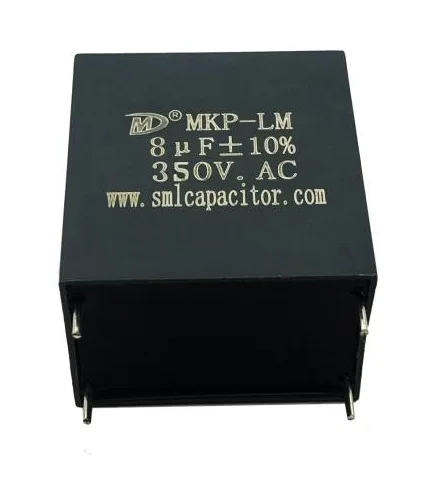
AC filtering and reactive power applications
The MKP-AL page describes AC filtering and high-frequency harmonic processing. Its application list includes reactive power compensation, power systems and energy storage equipment, and low-voltage parallel circuits. These descriptions place the series in an AC application context; they do not establish a complete design for a capacitor bank or guarantee a particular power factor improvement.
Explain the capacitor's intended role in your equipment. If the requirement comes from a system study, provide the relevant operating assumptions and the required electrical result. If it is a replacement, identify the existing configuration and the reason for the change. State whether the inquiry concerns one component or a complete assembly requirement. The manufacturer can then review an actual capacitor duty without having to infer the system design from a short request for an AC filter capacitor.
Confirm phase configuration before comparing values
Both single-phase and three-phase filtering are described in the published product information. The chosen phase arrangement must be made explicit in the proposal. A capacitance value without its connection context can be ambiguous, particularly when different quotations describe a component, a phase, or a complete assembly in different ways.
Ask the technical team to identify the proposed connection arrangement and explain how each stated electrical value relates to it. Keep that information with the drawing and quotation. This page does not merge catalog table values into a universal capacitance range, and buyers should not infer the phase configuration from a capacity number alone. For a replacement, send the existing schematic or connection information as well as the marked values. That provides a more reliable basis for comparison than matching a single number on the housing.
Use the AC voltage range with the system conditions
The published MKP-AL voltage range is 300 to 690 VAC. This describes the series, while a procurement decision still needs a specific rated configuration. Provide the intended system voltage, frequency, operating variation, and any harmonic information relevant to the capacitor's duty. Where the system conditions come from measurements, identify the measurement point and the equipment state.
Do not choose a part only because the normal supply voltage falls within the family range. Ask for the applicable operating limits and the electrical data of the proposed configuration. If a reactor or other equipment is part of the intended circuit, include that context in the technical brief. This is a selection checklist rather than a claim that a particular arrangement has already been assessed. The accepted specification should clearly identify the conditions used for approval.

Oil filling and aluminum housing are documented features
MKP-AL uses metallized polypropylene film with an aluminum shell and oil filling. This construction differs from the resin-filled DC-link and snubber families elsewhere in the catalog. Keep the filling description tied to the correct model, particularly when several capacitor types are being sourced for the same equipment project.
For a mechanical review, provide the available space, mounting interface, connection routing, and surrounding assembly constraints. Ask for the drawing of the exact proposed configuration. The source describes heat dissipation and compactness qualitatively, but those descriptions should not replace a thermal or fit assessment in your cabinet. Confirm the handling and installation information that applies to the selected part. A family construction summary is useful for shortlisting; the approved drawing and specification remain the documents that define what purchasing expects to receive.
Terminal choices and protection provisions need detail
The source lists fast-on, screw, and clamp terminal options and describes an overpressure disconnector. These are meaningful features to review during selection. Their presence does not mean every terminal arrangement is available for every rating, or that the capacitor replaces the protection design required for the complete equipment.
Identify the intended conductor interface and ask which terminal version is proposed. Request the relevant installation guidance, including any space or mechanical provisions needed by the protective arrangement. Keep those requirements visible in the assembly drawing rather than treating them as optional notes after procurement. If your equipment specification requires a particular protection or documentation scope, state it explicitly. The catalog description establishes that protection features are discussed for the family; it does not independently verify the behavior of your finished installation under every possible fault condition.
Specify the result required from a compensation project
For reactive power compensation purchasing, a useful inquiry explains the system requirement and how the proposed capacitor will be connected. If you have a required reactive output, state its operating voltage and frequency context. Ask the supplier to clarify how the proposed capacitance, current, and phase arrangement correspond to that requirement, rather than assuming a catalog capacity figure has the same meaning in every configuration.
Plan evaluation with the equipment team and identify the observations needed before approval. Those may include fit, connection identity, and electrical and thermal behavior under the intended operating conditions. This is a proposed buyer process, not evidence of a completed compensation study or promised energy savings. Keep any expected system outcome separate from the component's confirmed specification. A carefully defined requirement helps avoid buying a correctly labeled capacitor for an incompletely defined application.
Have a drawing or target specification?
Include it in your first message so the conversation starts with your equipment requirements.
Start a technical inquiryBuild a quotation brief around the AC connection
For MKP-AL, put the phase and connection arrangement beside the electrical requirement in the inquiry. State the operating voltage, frequency, required capacitance or reactive output, and the harmonic information available to the design team. Explain the basis of any capacity figure so that a supplier does not have to guess whether it describes a phase, a component, or an assembly.
Attach the intended mechanical envelope, mounting interface, terminal preference, and conductor arrangement. Where the installation uses additional components, include the circuit context relevant to the capacitor. Ask for a configuration-specific drawing and specification, including the installation information associated with the described protection provision. If an existing unit is being replaced, provide its connection details and approved requirements rather than only a photograph of the marked value.
State evaluation quantities separately from expected production demand and request the current minimum quantity, availability, packaging, and delivery terms. If approval documentation is required for the destination or equipment, identify it before accepting the proposal. These are buyer preparation steps, not promises of included services or fixed timing. Compare offers only after confirming they address the same phase arrangement and electrical duty.
Connect terminal selection to the intended conductor interface
The MKP-AL description lists fast-on connections, an M10 screw option, and M5 and M6 clamp options. These are distinct interfaces rather than alternative names for the same terminal. The relevant choice depends on the conductor arrangement intended for the AC assembly and the connection geometry shown for the proposed capacitor.
For a mechanical comparison, identify the conductor type, approach direction, available access, and adjacent components. A clamp-style option and a fast-on option may require different assembly provisions even when the capacitor bodies look similar. Do not infer tightening instructions from the nominal terminal designation or from another model's installation sheet. The drawing and instructions for the selected part should establish the actual interface.
Protection adds another installation question. MKP-AL is described with an overpressure disconnector, so the mechanical arrangement should account for the applicable protection provisions rather than treating the component as an unrestricted solid envelope. No universal movement allowance is specified here. Ask for the installation requirement of the exact proposed configuration. These interface considerations help choose among the documented options without claiming that a terminal style or protective device guarantees a particular system-level result.
Keep overload limits distinct from insulation test levels
The MKP-AL specification lists maximum overvoltage at 1.1 times rated voltage and maximum overcurrent at 1.3 times rated current. It separately lists a between-terminal voltage test at 2.15 times rated voltage for 5 seconds and a terminal-to-case test at 3600 VAC for 2 seconds. These entries have different purposes; the short-duration test levels are not additional normal supply-voltage options.
For an AC application, compare the intended operating duty with the applicable operating limits, then examine insulation-test requirements separately. The overload entries should not be assumed to authorize any duration or any combination of stresses that the agreed specification has not addressed. In particular, a multiplication factor alone does not explain the whole operating pattern of a harmonic filtering or compensation installation.
Capacitance tolerance is another separate item, listed as plus or minus 5 percent or plus or minus 10 percent. The designer should choose the needed tolerance in the context of the required phase arrangement and circuit function. Keeping operating limits, test levels, and tolerance in separate rows of a technical comparison makes the proposed capacitor easier to assess without converting one favorable catalog number into a broad performance guarantee.
Frequently asked questions
Is MKP-AL oil-filled or resin-filled?
The product page identifies oil filling in an aluminum shell with metallized polypropylene film. Do not copy the resin-filled construction description from other capacitor families. Request the selected part drawing and relevant installation information for your equipment.
Are both single-phase and three-phase versions described?
Yes. The source describes single-phase and three-phase filtering. Confirm the proposed phase and connection arrangement explicitly, and ask how stated capacitance and other electrical values relate to it. A capacity number alone should not be used to infer the configuration.
Which terminal options are listed?
Fast-on, screw, and clamp options are listed for the family. Confirm the terminal arrangement available for the proposed rating and request its interface details. The family description does not establish that every rating uses every terminal style.
Does the overpressure disconnector replace system protection?
No such system-level claim is made here. The product page describes an overpressure disconnector, but equipment protection and installation requirements still need their own review. Request the applicable guidance and make any required provisions visible in the assembly design.
What should I send for a reactive power compensation inquiry?
Send the intended voltage, frequency, phase arrangement, required reactive output or capacitance, available harmonic information, and connection context. Include the mechanical envelope and clarify whether the request concerns a single component or a larger assembly requirement.
Sources & technical reading
External references explain general engineering principles. They do not establish SMILER product ratings or approvals.